
Introduction
Travel plans can change quickly when travel updates involve flight disruptions, airspace restrictions, weather, border rules, or government advisories. In August 2026, travelers in several regions are dealing with changing flight operations and security-related travel guidance, making it more important than ever to check current information before leaving home.
A flight that was scheduled normally yesterday may be delayed or rerouted today. An airport may introduce different procedures, while a destination’s entry or safety requirements can change with little notice. These changes do not necessarily mean you should cancel a trip, but they do mean you should verify your plans using current official information rather than relying only on an old booking confirmation.
This travel update guide explains the most important developments travelers should watch, what to check before going to the airport, and how to reduce the risk of unexpected problems during a trip.
At a Glance: The Most Important Travel Updates Right Now
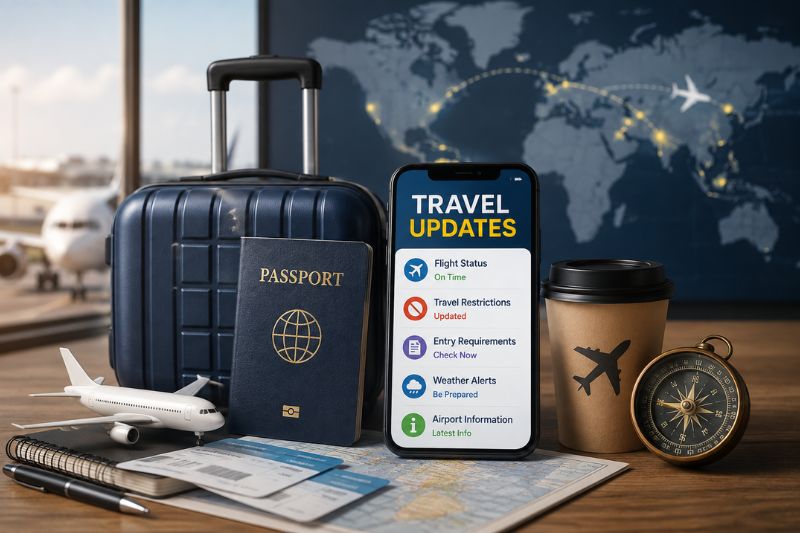
Here are the key things travelers should check before departure:
- Check your flight status directly with your airline on the day of travel.
- Review current government travel advice for your destination, especially if traveling through a region affected by security concerns.
- Check airport and airspace conditions if your route passes through the Middle East or other areas experiencing disruptions.
- Allow extra time at airports when airlines or airports announce operational changes.
- Review entry requirements, including passports, visas, electronic authorizations, and health documentation where applicable.
- Watch weather warnings before road trips and domestic travel, particularly during periods of heavy rain or extreme weather.
- Keep alternative arrangements in mind if your route depends on a potentially disrupted airport or airspace.
Current travel information is particularly important for people traveling through parts of the Middle East. Recent reports show that airlines have continued to adjust or suspend some services because of regional security developments and airspace restrictions.
Why Travel Updates Matter More Than a Booking Confirmation
A confirmed ticket tells you that you have a reservation. It does not guarantee that the flight will operate exactly as originally scheduled.
Airlines can change departure times, routes, terminals, or connections because of operational, security, weather, or airspace conditions. In some situations, flights may be suspended temporarily.
For example, SalamAir currently reports suspensions affecting flights to and from Iran and Azerbaijan, as well as Beirut, because of regional airspace and security developments. The airline also advises passengers departing from Pakistan to arrive at the airport at least four hours before departure.
This is why travelers should check information at multiple points:
- When booking — understand the route and connection points.
- Several days before departure — look for policy or schedule changes.
- The day before travel — confirm the latest flight information.
- Before leaving for the airport — check the live status again.
- During a connecting journey — monitor the next flight instead of assuming the original schedule remains unchanged.
The closer you get to departure, the more valuable current information becomes.
Middle East Travel Update: Check Flights and Airspace Carefully
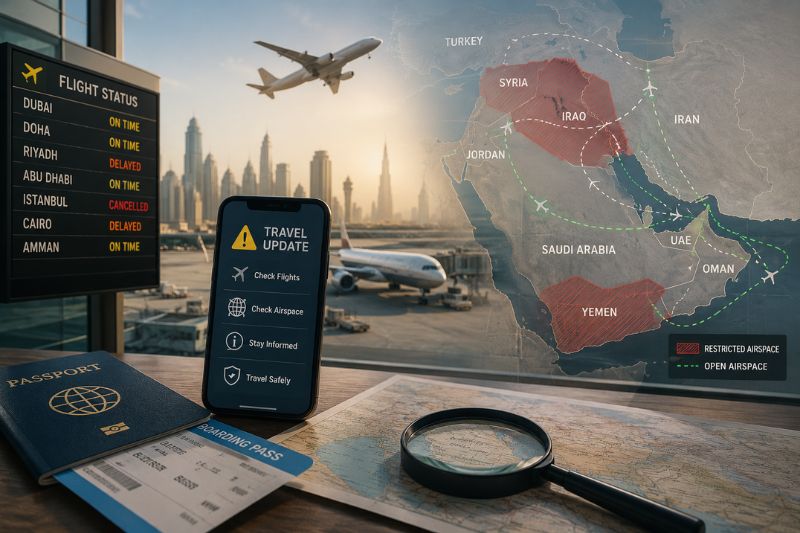
The Middle East remains one of the areas where travelers should pay particular attention to current flight information.
Recent travel reporting indicates that several airlines have adjusted or suspended services involving destinations in the Gulf and surrounding region. Travelers have been advised to check their flight status before heading to the airport because schedules can change as conditions develop.
Some airlines are also publishing their own operational updates. For example, SalamAir lists temporary suspensions and other passenger instructions on its travel-update page.
The important lesson is simple: do not assume that a route is operating normally just because you purchased the ticket weeks ago.
If your journey involves a connection through Dubai, Doha, Bahrain, Kuwait, Saudi Arabia, Oman, or another regional hub, check the status of every flight segment, not just the first flight.
Also check whether your airline has changed:
- Departure or arrival times
- Terminal information
- Connection arrangements
- Baggage procedures
- Check-in requirements
- Minimum connection times
- Alternative routing
- Cancellation or rebooking options
A small schedule change can become a major problem if it causes you to miss a connecting flight.
Travel Advisories Can Be Different From Flight Updates
A flight may still be operating even when a government has issued a travel advisory for the destination.
These are two different things.
An airline update generally tells you about the operation of a particular flight or route. A government travel advisory provides broader information about security, entry requirements, health risks, natural hazards, local laws, and other conditions that could affect travelers.
For example, Ireland’s current travel advice for Pakistan, updated August 21, 2026, advises a high degree of caution and specifically warns travelers against non-essential travel to Pakistan-Afghanistan border regions following cross-border clashes.
Similarly, Canada’s travel-advice guidance explains that official advisories can cover entry and exit requirements, health, local laws, natural disasters, climate, and emergency information.
Before international travel, check both sources:
- Your airline for flight and operational information
- Your government’s official travel advice for destination-specific risks and requirements
Neither source should automatically replace the other.
What to Check Before You Leave for the Airport
One of the easiest ways to avoid travel problems is to perform a final pre-departure check.
1. Confirm Your Flight Status
Check the airline’s official website or app shortly before leaving for the airport.
Look for:
- Delays
- Cancellations
- Terminal changes
- Gate information
- Revised departure times
- Check-in instructions
Do not rely only on an old email or screenshot.
2. Check Your Travel Documents
Make sure your passport, visa, electronic travel authorization, tickets, and other required documents are valid for the specific destination.
Entry requirements can differ even between countries that appear similar on a travel itinerary.
3. Check the Route, Not Just the Destination
A destination may be operating normally while a connecting airport or transit country is experiencing disruption.
If you have two or three flight segments, investigate the entire route.
4. Check Weather and Local Conditions
Weather can affect both flights and road travel.
In Pakistan, for example, the National Highways & Motorway Police has issued advisories during periods of monsoon rain, warning travelers about slippery roads, reduced visibility, and increased accident risks.
If you are driving, check road conditions before departure rather than waiting until you encounter a closure or dangerous weather.
How to Handle a Delayed or Canceled Flight
Even with careful planning, a flight can be delayed or canceled. The most useful thing you can do is act quickly while keeping your travel documents and booking information accessible.
If your airline announces a disruption, follow these steps:
1. Check the Airline’s Official Update
Start with the airline rather than social media posts or unofficial travel pages. Look for the latest information about your flight number, departure airport, destination, and revised schedule.
If the airline provides an app, enable notifications so you can receive schedule changes as soon as they are published.
2. Do Not Immediately Leave the Airport
If your flight is delayed, do not assume that it has been canceled unless the airline confirms it.
A delay can sometimes be reduced, extended, or changed again. Keep checking the official flight status and airport announcements.
3. Understand Your Rebooking Options
When a flight is canceled, the airline may offer alternatives such as:
- Rebooking on another available flight
- A later departure
- An alternative route
- A refund, depending on the applicable fare and passenger-rights rules
- Other assistance where required by the airline’s policy or applicable law
The exact options depend on the airline, ticket conditions, route, and reason for the disruption.
4. Protect Your Connecting Flights
A delay on the first flight can affect the entire itinerary.
If you have a connection, check whether the airline has automatically rebooked the complete journey. Do not assume that changing one flight automatically fixes every segment.
This is particularly important when separate tickets were purchased from different airlines.
International Travelers Should Check Entry Requirements Before Departure
Flight information is only one part of travel planning. Entry requirements can determine whether you are allowed to board or enter a country.
Depending on the destination, travelers may need:
- A valid passport
- A visa
- An electronic travel authorization
- Proof of onward or return travel
- Evidence of accommodation
- Specific health documentation
- Proof of sufficient funds
- Additional documents for transit
Requirements can also depend on your nationality, the purpose of your trip, the length of your stay, and whether you are entering or merely transiting through a country.
For this reason, do not rely on information from an old blog post or a travel video. Check the destination’s official immigration, embassy, or government website before departure.
Transit Rules Matter Too
One commonly overlooked issue is the transit country.
Suppose your final destination allows visa-free entry for your passport, but your flight connects through another country. You may still need to satisfy that transit country’s requirements.
Before booking or traveling, check:
Home country → Transit country → Final destination
This simple check can prevent problems at check-in or immigration.
What Travelers Should Do When Travel Advisories Change
A government travel advisory does not always mean that every traveler must cancel a trip. Advisories can contain different levels of guidance, and specific regions within a country may have different risks.
Read the advisory carefully and identify:
- Which locations are affected
- What type of risk is being described
- Whether the advice applies to the entire country
- Whether border areas have separate warnings
- What precautions are recommended
- What emergency assistance is available
Avoid interpreting a headline without reading the underlying advisory.
For example, Ireland’s current Pakistan travel advice distinguishes between general caution and areas where it advises against non-essential travel, including regions close to the Afghanistan border.
That distinction matters because travel conditions are not always identical across an entire country.
How to Prepare for Unexpected Travel Disruptions
You cannot prevent every disruption, but you can make yourself less vulnerable to one.
Keep Important Information Offline
Do not rely completely on mobile internet.
Save important details such as:
- Booking references
- Flight numbers
- Hotel reservations
- Emergency contacts
- Passport copies
- Insurance information
- Embassy or consular details
A phone can lose battery, mobile service can fail, or airport Wi-Fi can become unavailable.
Carry Essential Items in Your Hand Luggage
If your checked baggage is delayed, essential items should remain with you.
Consider keeping:
- Passport and travel documents
- Medication or essential personal items
- Phone charger
- Power bank where permitted
- Basic toiletries
- A change of clothes
- Important valuables
The goal is not to pack everything in your carry-on. It is to make sure that a short baggage delay does not immediately become a major problem.
Leave Extra Time for Important Journeys
If you are traveling for something that cannot easily be postponed—such as an examination, wedding, business meeting, medical appointment, or international connection—consider arriving earlier than you normally would.
A tight itinerary leaves fewer options when something goes wrong.
Travel Insurance Can Help With Some Disruptions
Travel insurance may provide protection for certain unexpected events, but coverage varies significantly between policies.
Depending on the policy, coverage may include things such as:
- Trip cancellation
- Trip interruption
- Medical emergencies
- Lost or delayed baggage
- Certain travel delays
- Emergency assistance
However, not every disruption is automatically covered.
Pay particular attention to exclusions involving:
- Known events
- Government travel warnings
- War or armed conflict
- Airspace closures
- Pre-existing circumstances
- Missed connections
- Airline-specific cancellations
Read the policy wording before purchasing rather than assuming that “travel insurance” covers every possible travel problem.
A Simple Travel Update Checklist
Before leaving home, run through this checklist:
| What to check | Why it matters |
|---|---|
| Flight status | Confirms whether your flight is operating normally |
| Departure time | Helps prevent missed check-in or boarding |
| Terminal | Airports can use different terminals for different flights |
| Passport | Ensures you have the required travel document |
| Visa/entry rules | Prevents problems at check-in or immigration |
| Transit requirements | A connecting country may have separate rules |
| Travel advisory | Helps you understand current destination risks |
| Weather | Can affect flights, roads, and local transportation |
| Hotel booking | Important if your arrival time changes |
| Travel insurance | Helps you understand what protection you actually have |
| Emergency contacts | Useful if normal travel arrangements break down |
This takes only a few minutes but can reveal problems before you leave home.
Common Travel Mistakes to Avoid
Relying on Old Travel Information
Travel rules can change. A guide published months or years ago may no longer reflect current visa, airline, border, or security conditions.
Better approach: verify important information through current official sources.
Checking Only the First Flight
Travelers often check their departure flight and forget about their connection.
Better approach: check every flight segment and the airports involved.
Trusting Social Media Before Official Sources
Social media can provide early reports, but individual posts may be incomplete, outdated, or incorrect.
Better approach: use social media to identify potential issues, then verify them through the airline, airport, or government source.
Ignoring Transit Requirements
A traveler may meet the entry requirements for the final destination but still face a problem during transit.
Better approach: check the requirements for every country on your itinerary.
Making a Tight Connection
A short connection may look efficient when everything operates normally. A small delay can make it impossible.
Better approach: consider realistic connection times, particularly when changing airports, terminals, or airlines.
Assuming Travel Insurance Covers Everything
Insurance policies have exclusions and conditions.
Better approach: read the policy before your trip and understand what events are actually covered.
What to Do If You Are Already Traveling
If a travel situation changes while you are abroad, avoid making decisions based only on rumors.
First, identify what has actually changed.
Ask:
- Is my flight still operating?
- Is my airport open and accessible?
- Has my destination issued new travel guidance?
- Has my airline provided alternative arrangements?
- Do I need to change my route?
- Does my travel insurance provide assistance?
- Where is the nearest official consular or emergency support?
Keep your phone charged and maintain access to your travel documents.
If you are in an area affected by a serious security, weather, or natural-disaster event, follow instructions from local authorities rather than attempting to move through an unsafe area simply to maintain your original itinerary.
Expert Tips for More Reliable Travel Planning
Check information at the right time. Checking your flight once when you book it is not enough for a journey several weeks away. Recheck important details as departure approaches.
Build flexibility into important trips. If missing an event would have serious consequences, consider arriving earlier instead of scheduling your arrival shortly before it.
Separate confirmed information from reports. An airline cancellation is confirmed information. A social-media post claiming that an airport may close is a report that still needs verification.
Keep a backup plan. For complicated international journeys, know what you would do if the first flight, connection, or accommodation becomes unavailable.
Use official sources for final decisions. Travel blogs and social media can help you discover issues, but official airline, airport, immigration, and government sources should generally be the final reference for current requirements and operational decisions.
FAQs
How often should I check my flight before traveling?
For an important international trip, check your flight status when departure approaches and again shortly before leaving for the airport. If the airline sends a notification, check the latest information immediately.
What should I do if my flight is canceled?
Check the airline’s official instructions first. Depending on the circumstances and ticket conditions, you may be offered rebooking, an alternative itinerary, or other options.
Are travel advisories the same as flight cancellations?
No. A travel advisory provides guidance about conditions or risks at a destination, while an airline cancellation concerns a specific flight or service.
Should I trust travel information on social media?
Social media can help identify developing situations, but it should not be your only source. Verify important claims through official airline, airport, government, or immigration sources.
What should I check before an international flight?
Check your flight status, passport validity, visa or entry requirements, transit rules, travel advisory, baggage requirements, airport information, and weather conditions.
Can a connecting flight be affected even if my first flight is operating?
Yes. A connection can be affected by delays, cancellations, airport restrictions, or changes affecting the second flight. Check every segment of your itinerary.
How to Verify a Travel Update From a Reliable Source
When you see a major travel story online, use a simple verification process.
Step 1: Check the Airline
Look for your airline’s official travel advisory or flight-status page.
Confirm your:
- Flight number
- Departure date
- Departure airport
- Arrival airport
- Connection
- Current departure time
Step 2: Check the Airport
Airports may publish their own operational notices. This is especially useful when there are weather problems, security restrictions, congestion, or terminal changes.
Step 3: Check Government Travel Advice
Government travel-advice pages can provide information that an airline may not cover, including regional security conditions and local restrictions.
The U.S. Department of State, for example, explains that its travel advisories provide risk assessments and recommended precautions for U.S. citizens traveling abroad.
Step 4: Check the Destination’s Entry Rules
If your trip is international, verify the latest visa and entry requirements with the relevant government or immigration authority.
Step 5: Compare the Information
If two sources appear to conflict, do not immediately assume one is wrong.
Check:
- Publication date
- Update date
- Exact route
- Specific airport
- Nationality requirements
- Whether the information applies to transit or final entry
The most recent official source that specifically applies to your journey should normally carry the most weight.
Travel Updates Can Affect Different Travelers Differently
A single travel event can have different consequences depending on the passenger.
For example, a traveler taking a direct flight may be unaffected while someone using the same airport as a connecting hub may face a missed connection.
Similarly, a government warning may apply only to a specific province, border area, or route rather than the entire country.
Australia’s current Pakistan travel advice, for example, says travelers should reconsider their need to travel and highlights the possibility of movement restrictions, road and transport disruption, and increased security operations.
That is why good travel planning should always ask:
“How does this update affect my exact itinerary?”
rather than simply:
“Is this country safe to visit?”
What to Do 24 Hours Before Your Trip
The final 24 hours are an important time for a travel check.
Review Your Flight
Check the airline’s latest status and confirm the departure time.
Check Your Airport
Make sure you know:
- Which terminal to use
- Where to check in
- Whether additional screening is expected
- How early you should arrive
Review Weather
Check conditions at both your departure and arrival locations.
If severe weather is expected, allow additional time for transportation to the airport.
Recheck Documents
Put your passport, visa, boarding information, hotel details, insurance information, and other essential documents somewhere easily accessible.
Charge Your Devices
Your phone is often your main source of:
- Boarding information
- Airline notifications
- Maps
- Hotel details
- Emergency contacts
- Translation tools
A charged phone can become especially important during an unexpected delay.
When Should You Consider Changing Your Travel Plans?
Not every travel update requires cancellation.
Consider changing your plans when an official authority or airline indicates that your route is significantly affected, when required transport is unavailable, or when the risk involved is inconsistent with your personal circumstances and the official guidance for the area.
Avoid making a major decision based solely on an alarming headline.
Instead, determine:
What changed? → Where did it change? → Does it affect my route? → What does the airline say? → What does the relevant government authority say? → What alternatives do I have?
This approach produces a much more useful decision than reacting to a general news story.
A Better Way to Plan Flexible Travel
If your itinerary is complicated or your destination is experiencing uncertainty, flexibility becomes valuable.
Where practical:
- Avoid unnecessarily tight connections.
- Keep important contact information available offline.
- Know the airline’s rebooking process.
- Consider refundable or flexible bookings when the additional cost is reasonable.
- Keep essential belongings in your carry-on.
- Avoid booking separate tickets with extremely short connections.
- Have an alternative route in mind.
- Monitor official updates throughout the journey.
Flexibility does not guarantee a smooth trip, but it gives you more options when circumstances change.
The Most Important Travel Update Rule
The most important rule is simple:
Never treat a travel update as universal. Check whether it actually applies to your specific trip.
A headline about flight cancellations may concern only certain routes. A security advisory may apply only to specific regions. A weather warning may affect one airport while another continues normal operations.
Good travelers therefore check the specific flight, route, airport, destination, and current official guidance before making decisions.
CONCLUSION
Travel updates are useful only when they help you make better decisions.
Before traveling, do more than check whether your ticket is confirmed. Verify your flight status, route, connecting airport, entry requirements, travel advisories, weather conditions, and airline instructions. For journeys involving areas experiencing security or airspace disruption, check these details again shortly before departure.
Current information is especially important because conditions can change quickly. Recent guidance concerning Pakistan highlights regional security issues and possible transportation disruption, while current aviation restrictions are also affecting particular routes.
The goal is not to become worried about every travel headline. It is to become better prepared.
A few minutes spent checking reliable information before leaving home can help you avoid missed connections, document problems, unnecessary airport trips, and unexpected disruption.
Stay informed, verify important updates through official sources, and make decisions based on your exact itinerary rather than general headlines.